
Put a ceiling on the amount you actually need
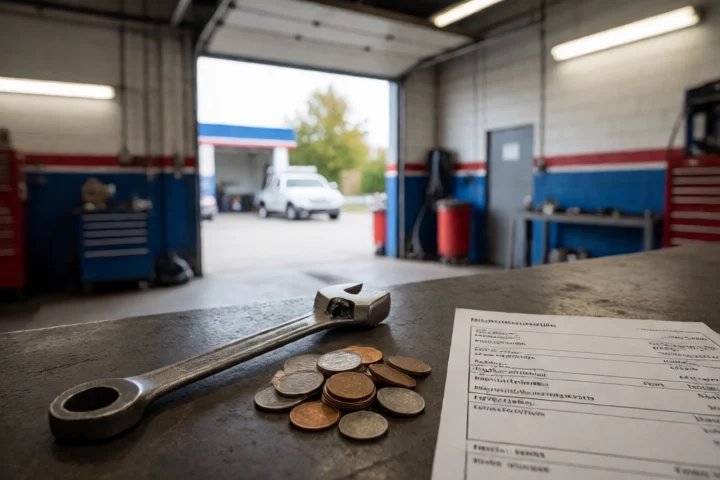
Start with the bill, not the advertised borrowing limit. Write down the amount due, subtract cash already available and any payment the provider will accept later, then record the date by which the remaining balance must be paid. That result is the gap. A $475 lender offer does little good when a $165 repair bill is the immediate problem and $310 would sit in the account long enough to become ordinary spending money with interest attached.
Repayment needs its own line. Take the next reliable income amount and subtract rent or mortgage, food, transportation, utilities, insurance, existing debt payments, and the loan payment. If the result falls below zero, the proposed due date relies on another loan, a missed bill, or an uncertain source of cash. Suppose an urgent bill is $240, $90 is available, and a provider agrees to accept $50 after payday. The borrowing gap is $100, not $240. A fallback also belongs in the calculation: a documented payment arrangement, available assistance screening, or an expense that can be deferred without creating a larger loss.
Apply the numbers to plausible household situations
The pressure behind a cash-loan search changes with the bill’s deadline and the income behind repayment. These Mechanicsville examples are hypothetical, built to show where the calculation changes.
Suppose a Mechanicsville worker needs a vehicle repair before a scheduled shift and receives a $380 estimate. The worker has $140 in savings and expects a regular $760 paycheck in eight days. Rent, fuel, groceries, and insurance already consume $650 of that paycheck.
The immediate gap is $240, yet only $110 remains after regular obligations. Borrowing the full repair estimate would create a repayment problem even though transportation supports income. A repair shop’s payment arrangement, a smaller necessary repair, or a reduced loan amount changes the arithmetic.
A loan payment above $110 leaves no room for the repair’s financial aftershock. The borrower needs a payment schedule that fits the actual remaining pay, or a different way to bridge part of the repair cost.
Suppose a household has a $190 utility shortage due before the next paycheck, which arrives in five days. The next check covers the shortage and regular expenses with $230 remaining after those commitments.
Here the amount and due date align more closely, but the household still needs the lender’s full repayment figure and withdrawal date. A lender charging the Virginia payday-loan maximum fee on a $190 advance would add up to $38, producing $228 due.
A payment arrangement that moves part of the utility balance past payday could reduce the borrowing need. If borrowing remains necessary, the household compares $228 against the money actually left after the check arrives.
Suppose a Mechanicsville resident with irregular seasonal work has a $300 housing-related gap and expects income within two weeks, without a firm payment date or amount.
Expected income is not yet a credible repayment source because its timing and size remain unsettled. A fixed loan due before that income arrives turns a housing gap into a collection risk.
Hanover County assistance screening and 2-1-1 Virginia referrals have particular value in this situation because reducing the gap removes pressure to borrow against income that has not arrived.
Hanover County Department of Social Services · Virginia State Corporation Commission — Payday Loans
A wider choice set than one loan offer
Cash loans compete with several ways to shrink the gap. Speed matters when a bill is due today, but cost and repayment strain matter as soon as the due date moves beyond today.
| Route | Speed | Likely Cost | Eligibility Friction | Main Risk |
|---|---|---|---|---|
| Bill payment arrangement | Depends on the utility, landlord, repair shop, or other provider | Often lower than a new loan; terms vary | Provider approval and an account in acceptable standing | A missed arrangement payment can leave the original bill unresolved |
| Hanover County Department of Social Services or 2-1-1 Virginia referral | Program and referral timing vary | Public-assistance screening and referrals do not create loan interest | Program rules, documentation, and available resources | Assistance may not meet the deadline or cover the full expense |
| Credit-union small-dollar option | Institution underwriting and membership timing vary | Potentially lower-cost regulated borrowing | Membership and lender requirements | The product may not be offered or approved in time |
| Online installment-loan offer, such as SoFi Personal Loans or LendingClub Personal Loans | Application and funding timing vary by applicant and lender | APR and origination charges require direct comparison | Credit and underwriting requirements | Longer repayment can turn a small gap into a larger total obligation |
Hanover County Department of Social Services · Virginia Credit Union — official information
The city and county context worth verifying
Mechanicsville sits in Hanover County, which gives a borrower one concrete local branch before taking the full cash-loan amount: the Hanover County Department of Social Services serves as a county-government entry point for public-assistance programs and services. 2-1-1 Virginia adds a searchable referral directory for food, housing, utilities, health care, employment, and other community support. Those routes change the borrowing calculation when an expense falls into one of those categories; a referral or program screen may reduce the amount that must be financed.
Virginia law also changes the terms attached to a payday loan. State-regulated payday lenders face a $500 principal cap, a finance-charge limit of 20% of the amount advanced, and a prohibition on rollovers. Those limits are real protections, though they do not establish that a payment fits a particular Mechanicsville household’s next income date.
Hanover County Department of Social Services · Virginia State Corporation Commission — Payday Loans
A side-by-side test for competing loan terms
An offer becomes comparable only after every lender is placed on the same calendar. Record the dollars due from start to finish, each payment date, every disclosed charge, and the terms for early payoff or cancellation. A two-payment installment offer and a single-paycheck loan belong on one list of dated payments, since a lower individual payment can still produce a larger overall repayment.
| Offer | Total Repayment | Payment Timing | Fees And Charges | Payment Frequency | Exit Flexibility |
|---|---|---|---|---|---|
| Offer 1: single-payment cash loan | Principal plus every disclosed finance charge | Exact withdrawal or payment date | Finance charge, late charge, returned-payment charge | One scheduled payment | Early payoff, cancellation, and payment-change terms |
| Offer 2: installment loan | Sum of all scheduled installments and disclosed charges | List each installment date | APR, origination charge, late charge, returned-payment charge | Weekly, biweekly, semimonthly, or monthly | Early payoff, cancellation, and payment-change terms |
| Offer 3: federal credit-union Payday Alternative Loan | Amount borrowed plus permitted interest and application fee | Scheduled term and payment dates | Terms range from one to six months for PALs I and one to 12 months for PALs II | Terms supplied by the credit union; membership and availability apply |
Pause when these warning signs appear
Trouble often appears before a borrower signs: the repayment figure is absent, the payment date is vague, fees are scattered through separate screens, or the lender’s identity cannot be matched to Virginia regulation. A loan that depends on taking another advance at maturity also fails the affordability test. Virginia payday loans cannot be rolled over, but a household still needs enough cash to pay the scheduled balance without replacing it with another debt.
Automatic payment authorization deserves close reading because the account withdrawal date has the same force as the due date. Late-payment and returned-payment consequences belong in the written terms alongside the principal, finance charge, and total repayment.
Your pre-application decision check
A completed set of facts produces a clearer go-or-stop decision than a lender’s advertised maximum. Each point below should have a visible answer before an application moves forward.
- Exact gap recorded: the bill amount, available cash, accepted payment delay, and remaining amount are written down.
- Repayment source identified: reliable income arrives before the scheduled payment date and remains sufficient after regular obligations.
- Lender identity matched: the business is licensed or regulated for the product it offers in Virginia.
- Written terms available: principal, finance charge, APR where stated, total repayment, payment dates, and late or returned-payment consequences appear together.
- Payment authorization understood: the account to be charged, withdrawal timing, and any authorization terms are clear.
- Payoff and cancellation terms recorded: early-payment treatment and any cancellation process are stated in the offer.
- Privacy terms read: the application explains how personal and financial information will be handled.
- Fallback identified: a payment arrangement, assistance screen, or other response exists if income arrives late or the expense changes.