
A local lens for access, work, and payment timing
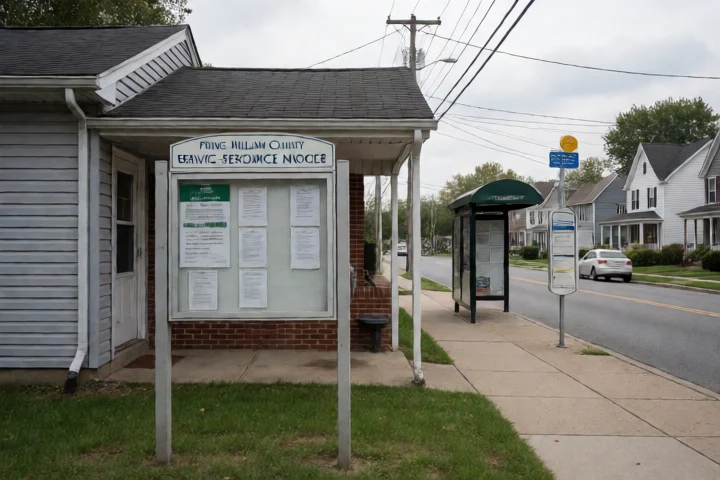
Lake Ridge sits in Prince William County, so a household confronting a utility, food, housing, health-care, or similar basic-needs gap has countywide and statewide referral paths worth weighing before financing the entire expense. Prince William County Department of Social Services serves as a starting point for public-assistance information and related services. 211 Virginia maintains a searchable directory for food, housing, utilities, health care, and other community resources. Those services change the borrowing calculation when assistance, a payment arrangement, or a partial resource reduces the cash gap.
Virginia places consumer finance companies under the oversight of the State Corporation Commission, and the state’s Consumer Finance Companies framework governs lending by licensed consumer finance companies. That inquiry belongs beside the repayment review because a lender’s marketing description does not itself explain the legal framework for the transaction.
Compare the full repayment, not the headline amount
Federal closed-end credit disclosures include the annual percentage rate, finance charge, amount financed, total of payments, and payment schedule.
Then place the first and final due dates beside the same income calendar. This converts a sales headline into a repayment obligation with dates attached, which is considerably less glamorous and much more informative.
| Cash Received | Repayment Schedule | Full Repayment | Payment Risk | Exit Terms | Offer |
|---|---|---|---|---|---|
| Amount actually advanced after any stated deductions | Each payment amount, frequency, first due date, and final due date | Sum of every scheduled payment and any disclosed charge due under the agreement | Whether each due date lands after identified income and essential bills | Early-payoff amount, cancellation terms, and any stated fees | |
| Amount actually advanced after any stated deductions | Each payment amount, frequency, first due date, and final due date | Sum of every scheduled payment and any disclosed charge due under the agreement | Whether each due date lands after identified income and essential bills | Early-payoff amount, cancellation terms, and any stated fees | |
| Amount available for the same identified expense | Payment amounts and dates supplied by the institution or program | Scheduled repayment or any required contribution stated by the provider | Fit with the household income calendar and current obligations | Membership, qualification, payoff, or program conditions | Credit-union or community option |
Name the expense, deadline, and repayment source
The loan amount should begin with the gap, not with the largest figure an application displays. A household can write four lines: expense due; cash already available; confirmed help or payment extension; remaining shortfall. If a repair invoice is $620, $170 is available, and a confirmed $150 arrangement covers part of the bill, the remaining gap is $300. The repayment source then needs its own line: a particular paycheck, benefit payment, or other dependable income after rent, food, utilities, transport, and existing debt payments.
Deadline and income date create the turning point. A $300 need due Tuesday carries one set of pressures when reliable income arrives Friday and another when it arrives three weeks later. The first case still requires a payment schedule that survives the next bill cycle. The second points toward reducing the expense, seeking a payment arrangement, or finding assistance before adding a recurring installment. A lender’s offered maximum has no special knowledge of the household budget; it is merely an offered maximum.
What to try before taking the full loan amount
A shortfall often has more than one component: an immediate bill, a timing problem, and a gap between household resources. Reducing any component reduces the amount that must be repaid. Availability, eligibility, and turnaround vary by provider, so each route needs direct confirmation before it becomes part of the household plan.
| Route | Speed | Likely Cost | Eligibility Friction | Risk |
|---|---|---|---|---|
| Bill payment arrangement | Depends on the biller and the account status | Potentially lower than new credit, subject to the biller’s terms | Account review or a conversation with the provider | An arrangement that still exceeds the next income period leaves the gap unresolved |
| Prince William County assistance screening or 211 Virginia referral | Program and referral timing vary | Public or community assistance rather than loan repayment | Program rules, documentation, and available resources | Help may cover only part of the expense or arrive after the deadline |
| Credit-union comparison | Terms vary by institution and product | A payment schedule still has to fit the household budget | ||
| Partial payment from current funds plus a smaller loan | Depends on the biller and lender | Requires a settled bill amount and loan approval | Using all available cash can expose the household to the next essential expense |
Shortfall scenarios with different exit paths
These are hypothetical Lake Ridge situations, offered to show how the same product type changes shape once the deadline and repayment source become specific.
A hypothetical worker needs a vehicle repair to keep reaching a job. The shop requires $480 before releasing the vehicle, while $180 remains in the household account. A paycheck of $550 arrives in four days, followed by rent and utility obligations the next week.
The worker seeks the shop’s payment terms and identifies the amount left after the upcoming rent, utilities, food, and transport needs.
A smaller financing amount or repair arrangement has a stronger basis when the remaining paycheck covers the scheduled payment and essential bills. If it does not, the transportation problem remains urgent while the proposed repayment plan fails its own exit test.
A hypothetical household faces a utility balance due before its next reliable income date, which is two weeks away. Income varies because one household member works irregular shifts, and the amount expected from the next pay period remains uncertain.
An installment loan tied to a fixed due date shifts uncertainty into the repayment calendar. The household contacts the utility provider about payment timing and searches 211 Virginia and county assistance information for resources connected to the bill.
Assistance or an arrangement that covers part of the utility balance narrows the borrowing gap. If the remaining amount still requires a fixed payment before reliable income arrives, the household has identified a mismatch instead of merely postponing it.
Pause when these warning signs appear
Trouble starts when repayment depends on borrowing again. A plan that needs a second loan, a skipped essential bill, or an uncertain future paycheck to make the first scheduled payment has exposed an affordability problem. Repeated borrowing turns a one-time expense into a recurring claim on income, often while the original household pressure remains.
Automatic payment authorization deserves the same attention as the payment amount. Borrowers should know the account involved, the payment dates, the authorization’s scope, and the consequences stated for late or returned payments. Unclear figures around the annual percentage rate, finance charge, payment schedule, total of payments, or early payoff prevent a meaningful comparison. An unresolved handling issue with a lender can be submitted through the Consumer Financial Protection Bureau’s complaint process; eligible Prince William County residents facing debt collection, consumer, housing, or benefits issues also have Legal Services of Northern Virginia as a potential civil legal-aid route.
A final checklist before you apply
A completed comparison produces a go-or-stop decision from actual dates and amounts, not from a headline promise.
- Exact expense, deadline, available cash, and remaining gap recorded in dollars.
- Repayment source identified by date and amount, with rent, food, utilities, transport, and existing obligations accounted for.
- Virginia lender identity and license status located through the State Corporation Commission for a covered consumer finance company.
- Loan disclosures available with the annual percentage rate, finance charge, amount financed, total of payments, and payment schedule.
- Every scheduled payment added to reach the full repayment figure.
- Each payment date placed against the household income calendar, with no payment dependent on uncertain income or further borrowing.
- Automatic payment authorization, late-payment consequences, returned-payment consequences, cancellation terms, and early-payoff terms understood before acceptance.
- Fallback identified for a denied application, a reduced income period, or an essential bill that remains after the proposed loan.