
Start with the amount and the timing gap
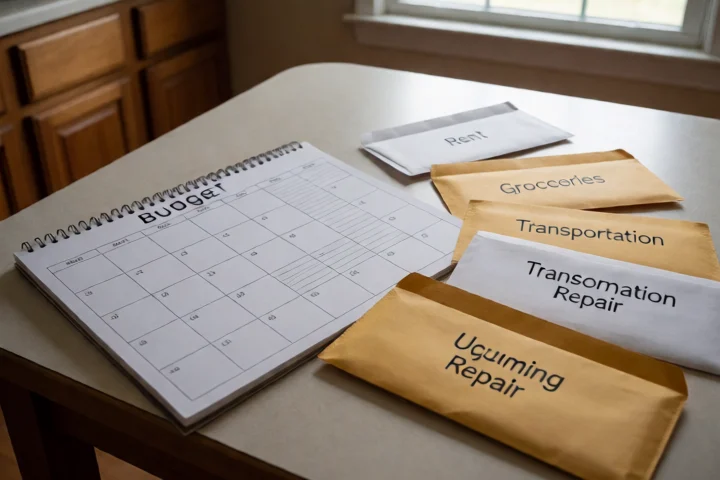
A borrowing decision starts with the unpaid balance due before the next income date, then subtracts cash already reserved for food, housing, transportation, insurance and existing debt payments. That result is the gap. A household facing a $680 bill due Friday, with $250 available after protected expenses and $500 arriving next Wednesday, has a $430 timing gap. Borrowing $680 because that is the bill amount would add debt where $430 addresses the immediate shortage.
Repayment needs its own line in the calculation. List each proposed loan payment beside the expected pay date, then subtract the bills already assigned to that pay period. If a $95 installment falls three days before income arrives, the payment does not fit simply because the monthly budget appears positive on paper. Timing is part of affordability.
A fallback belongs in the same calculation: a confirmed payment arrangement, funds already expected, a reduced expense, or an assistance referral. Without one, the first installment loan can become the reason for a second request. That sequence is expensive precisely because it begins with a small-looking payment.
Three ways the same cash gap can play out
The amount alone hides the different pressures that produce a Fair Oaks cash gap. These hypothetical situations show why a repayment date and the next month’s commitments deserve as much attention as the initial expense.
In a hypothetical Fair Oaks household, rent is due on the first and the next verified paycheck arrives on the fifth. The household is short $300 after setting aside food and transportation. A four-payment loan whose first due date lands before that paycheck creates a second gap immediately. A payment arrangement that moves the rent balance past the fifth changes the borrowing amount and may eliminate it.
A loan payment belongs only after the household maps its first due date against that fifth-of-the-month income.
Another hypothetical household receives an urgent medical bill, yet the following month already contains rent, childcare and an existing car payment. The bill is real, but the budget has no unused space for a new installment. A partial payment arrangement reduces the immediate gap while preserving the next month’s fixed obligations.
The medical bill’s deadline and the lender’s payment schedule create separate obligations.
A smaller financed amount or a delayed provider payment has greater value than a larger loan that forces repeat borrowing.
A hypothetical vehicle disruption leaves a Fair Oaks worker with an unexpected repair charge before a commute. Insurance, fuel and ordinary household expenses already consume the next pay period. The repair estimate establishes the immediate need, while the next two pay periods reveal whether an installment payment fits.
Transportation disruption affects both the repair bill and the cash needed to keep traveling to work.
The repayment plan needs room for continuing travel costs, not merely the repair invoice.
Alternatives to price before signing
The strongest comparison often begins with the bill itself. A creditor, provider or landlord may offer a payment date, partial payment or installment arrangement; availability and terms depend on that organization. Fairfax County also gives a local cash-gap decision a different branch: some emergency basic-needs expenses belong with assistance navigation before debt enters the picture.
| Route | Likely Speed | Likely Cost Category | Eligibility Or Friction | Main Risk |
|---|---|---|---|---|
| Bill payment arrangement or due-date change | Depends on the biller and deadline | Often lower than new consumer credit, subject to the biller’s terms | Requires contact with the creditor, provider or property manager | A missed arrangement can leave the original obligation unresolved |
| Fairfax County Coordinated Services Planning or Emergency Assistance | Depends on program referral, eligibility and the emergency | Non-loan route | County program rules and available referrals apply | Assistance may not match the bill, amount or deadline |
| Credit-union or community-based borrowing option | Depends on institution and application process | Terms vary by product and applicant | Membership, underwriting or account requirements may apply | Approval timing may fail to meet an immediate deadline |
| Installment loan | Depends on the lender and application process | Finance charge and other disclosed costs determine repayment | Lender underwriting and product terms apply | Scheduled payments can strain later pay periods |
Build the decision around real local expenses
Fair Oaks sits within Fairfax County’s service structure, so a household whose gap involves food, shelter, medical needs, utilities or another emergency basic need has a local referral path that changes the loan calculation. Fairfax County Coordinated Services Planning connects residents with health, housing, human-services and basic-needs information and referrals.
That local fact matters because it shifts the first comparison from loan size to the part of the bill that remains after available support or a provider arrangement. A household seeking help for an eligible emergency expense might face a smaller borrowing need; another household whose expense falls outside those programs still has a clearer record of the amount it must cover. 211 Virginia provides an additional statewide route for local referrals involving food, housing, utility, health and financial-support resources.
Virginia’s legal categories also matter. Consumer finance companies operate under Chapter 15 of the Virginia Code, while short-term loans are separately addressed in Chapter 18. Marketing language does not establish which rules govern a particular offer. A purported consumer finance lender should have an identifiable business and licensing status; Virginia requires a license for the business of making consumer finance loans, subject to statutory exceptions. The State Corporation Commission’s Bureau of Financial Institutions regulates consumer finance companies and other covered financial-services businesses.
Virginia Code Title 6.2, Chapter 18 — Short-Term Loans · Bureau of Financial Institutions · Virginia Code Title 6.2, Chapter 15 — Consumer Finance Companies
Compare cost, timing, and exit options together
Closed-end credit disclosures supply the common fields for a fair comparison: amount financed, finance charge, annual percentage rate, total of payments and payment schedule. Put every offer into those fields, even when one lender advertises a monthly payment and another presents biweekly payments. Payment frequency changes the calendar pressure; total of payments reveals the full dollars leaving the household.
Those tiers apply by portions of principal. The disclosed payment schedule and total repayment therefore carry more practical weight than a headline rate treated as though it applies to every dollar.
| Comparison Field | Offer One | Offer Two | Why It Matters |
|---|---|---|---|
| Amount financed | Record the cash actually provided | Record the cash actually provided | Shows whether each offer covers the defined gap |
| Total of payments | Add every scheduled payment | Add every scheduled payment | Shows the full repayment amount across different schedules |
| First due date and payment frequency | Place each due date beside expected income | Place each due date beside expected income | Exposes a payment that arrives before available cash |
| Finance charge, APR and listed fees | Record every disclosed charge | Record every disclosed charge | Prevents a low installment figure from hiding overall cost |
| Early payoff and cancellation terms | Record the stated process and any effect on repayment | Record the stated process and any effect on repayment | Shows the route out if income improves or the loan is unnecessary |
The failure points to identify in advance
Repeat borrowing is the central failure pattern. It appears when the first payment consumes money reserved for the next ordinary expense, leaving a fresh gap before the loan balance has fallen far enough. A payment schedule that works only if every future bill behaves perfectly is a schedule with very little margin; bills are famously indifferent to spreadsheet optimism.
Automatic-payment authorization deserves the same attention as the payment amount. The agreement should state the account used, payment dates, authorization terms and the consequences described for a late or returned payment. A borrower who does not understand that sequence lacks a reliable basis for fitting the loan into a bank balance.
Unclear disclosures are a stop condition. Closed-end credit disclosures include the APR, finance charge, amount financed, total of payments and payment schedule. An offer that leaves those fields vague, changes the repayment number during the process, or obscures the lender’s identity gives the borrower nothing stable to compare. Concerns about a financial product can be submitted to the Consumer Financial Protection Bureau; the Virginia Attorney General also accepts consumer-transaction complaints.
A final checklist before you apply
Application should follow a completed comparison, not replace one. Each item below has an observable answer. A missing answer is a reason to stop the application until the term or expense is clear.
- Exact need: the requested amount matches the remaining bill gap after available cash and any payment arrangement.
- Income fit: every proposed due date falls after identified income and leaves room for already scheduled essentials.
- Lender identity: the legal business name and licensing status are identifiable for a purported Virginia consumer finance lender.
- Disclosure record: amount financed, APR, finance charge, total of payments and full payment schedule are available together.
- Payment consequences: late-payment and returned-payment terms are stated before application proceeds.
- Account authorization: the agreement identifies the account, payment method, dates and authorization terms.
- Exit terms: cancellation and early-payoff procedures are stated in the loan materials.
- Fallback: a missed-income or unexpected-bill plan exists without relying on another loan.